WHOLE BLOOD IN TRAUMA RESUSCITATION
What have TOWAR and SWiFT actually taught us?
Whole blood has made a major comeback in trauma resuscitation. Physiologically, the rationale is compelling. But the recent SWiFT and TOWAR trials have challenged the assumption that whole blood is clearly superior to component therapy.
So where does whole blood fit in modern damage-control resuscitation?
The Bottom Line
Whole blood makes physiologic and operational sense
Observational studies generally favor it
Randomized prehospital trials have not shown superiority
Whole blood is part of the strategy—not the strategy itself
What is Whole Blood?
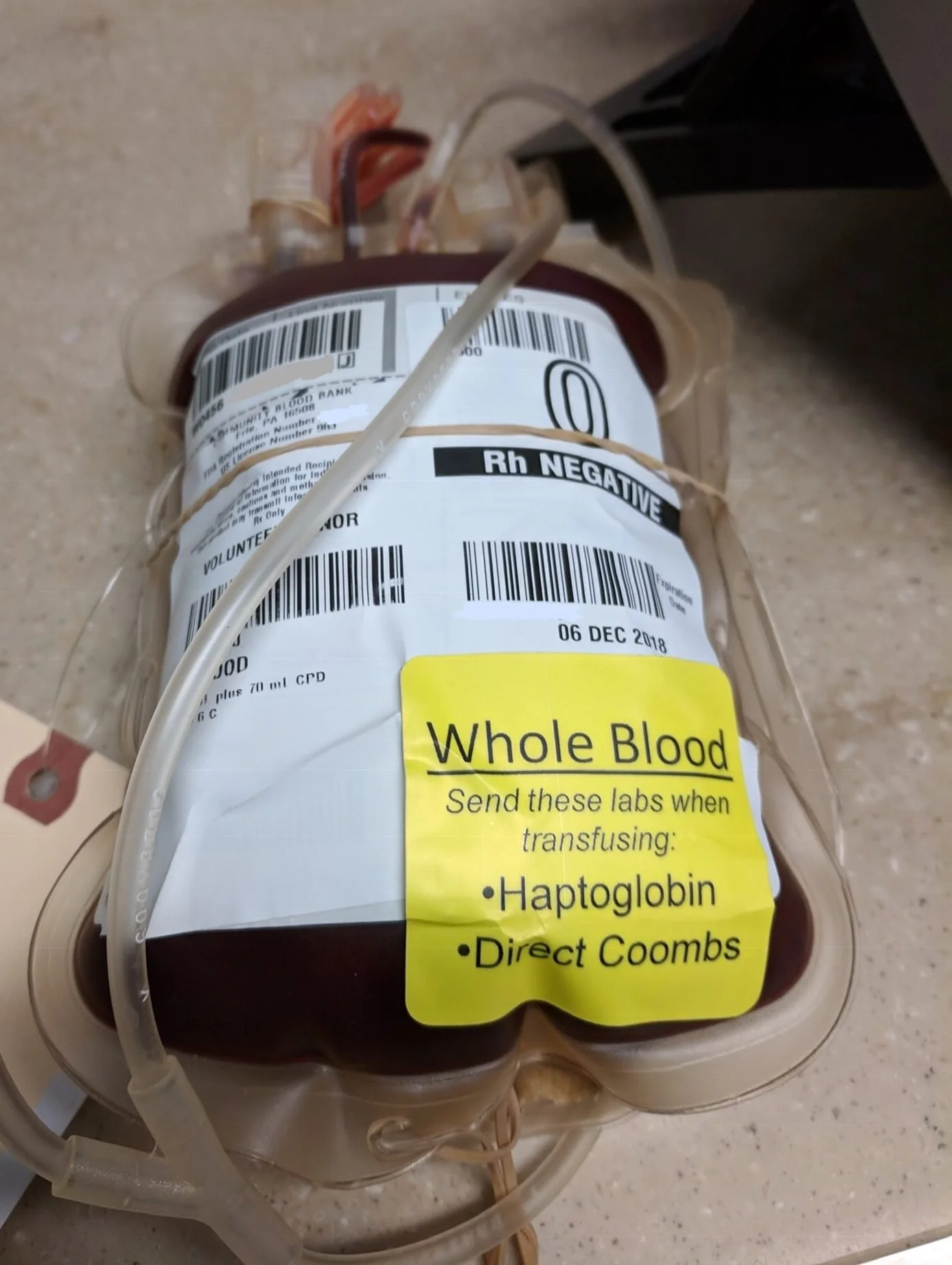
What is low-titer group O whole blood?
When we talk about whole blood in contemporary trauma care, we are generally referring to low-titer group O whole blood.
Group O allows broad ABO compatibility
Low titer means low anti-A and anti-B antibody levels, which reduces the risk of hemolysis
One unit provides:
Red blood cells
Plasma
Platelets
Coagulation factors
Volume
That gives whole blood two major advantages.
1. It’s physiologic
Whole blood more closely resembles what the patient is actually losing.
2. It’s logistically simple
Rather than coordinating separate red cells, plasma, and platelets, one unit delivers all three together. That matters early in a trauma resuscitation, during transport, and in austere settings.
Civilian observational data were impressive. A 2023 TQIP analysis of 2,785 patients with severe hemorrhage associated whole-blood use with a 37% reduction in 24-hour mortality and a 47% reduction in 30-day mortality. A separate multicenter prospective study involving more than 1,600 patients found almost a 50% reduction in the odds of death.
Another analysis found progressively lower mortality as whole blood made up a greater proportion of the overall resuscitation.
The signal was remarkably consistent.
The limitation was that most of these patients were not randomized.
Why did whole blood become so compelling?
Then the randomized trials arrived
In 2026, two major randomized prehospital trials—SWiFT and TOWAR—failed to demonstrate superiority of whole blood over contemporary component therapy.
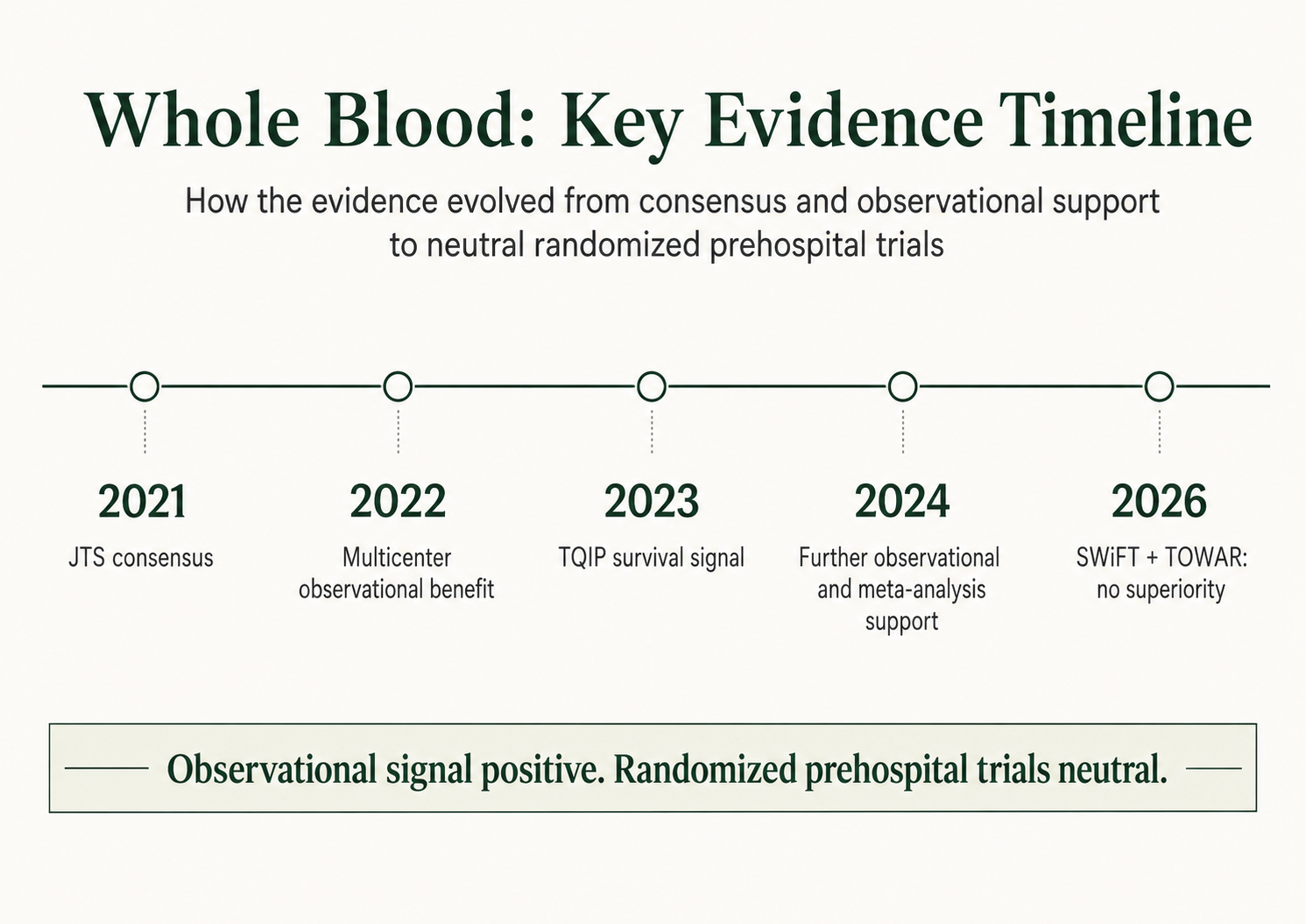
I don't think the appropriate conclusion is that whole blood “doesn't work.”
SWiFT and TOWAR primarily tested limited prehospital whole-blood exposure against good contemporary component therapy. They did not test an entire whole-blood-predominant massive transfusion strategy.
So perhaps whole blood didn't fail. Perhaps modern component resuscitation has simply become very good.
Whole blood is an excellent resuscitation product.
What remains unproven is whether it is superior to excellent component therapy.
How I Interpret the Evidence
How I Use Whole Blood
If LTOWB is immediately available in a patient with life-threatening traumatic hemorrhage, I think it is an excellent initial resuscitation product.
But whole blood and component therapy are not competing ideologies. Start with whole blood when available, transition into balanced components as necessary, and move toward goal-directed transfusion as more information becomes available.
Whole blood is a product.
Damage-control resuscitation is the strategy.
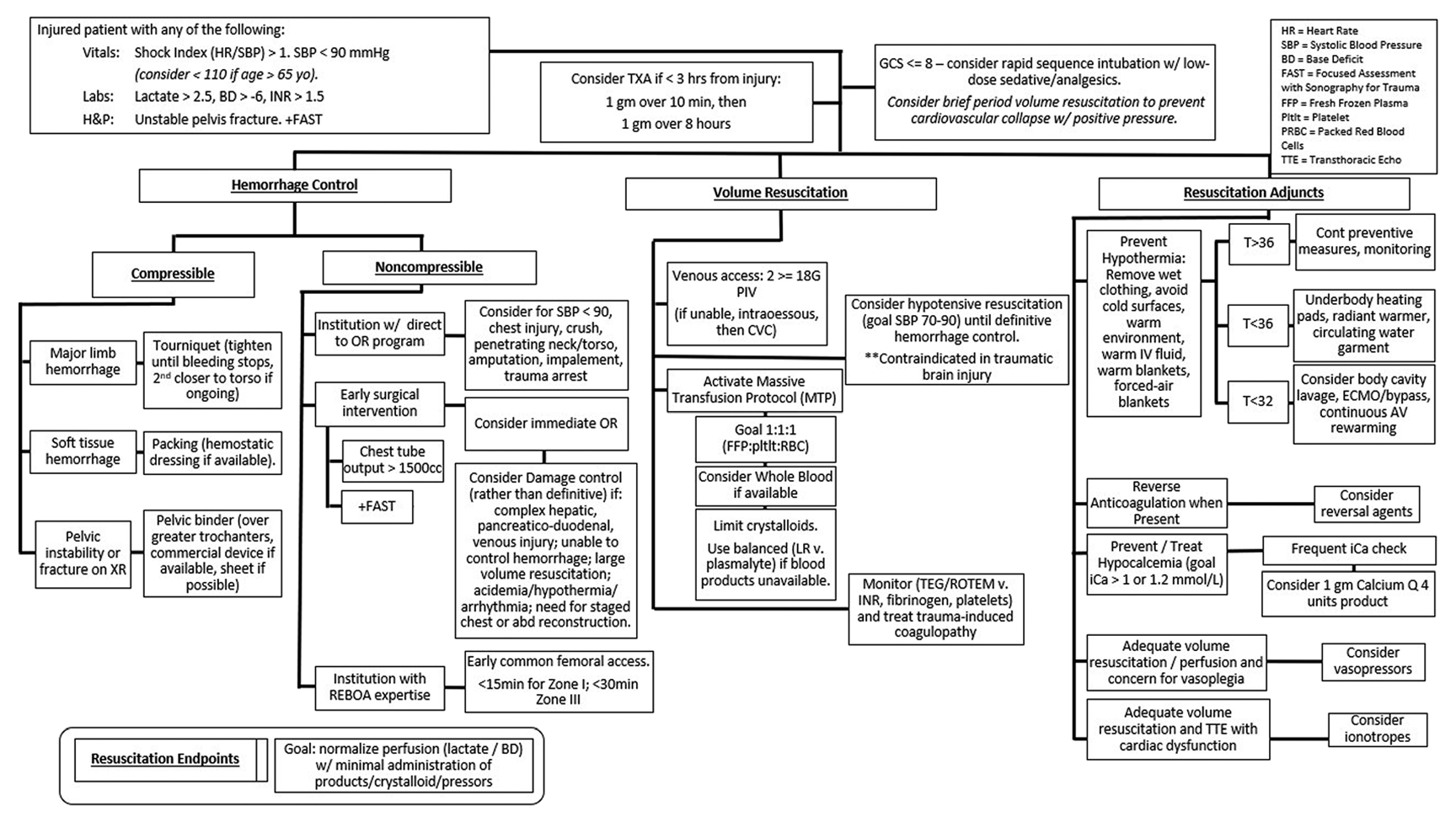
LaGrone LN, Stein D, Cribari C, Kaups K, Harris C, Miller AN, et al. American Association for the Surgery of Trauma/American College of Surgeons Committee on Trauma: Clinical protocol for damage-control resuscitation for the adult trauma patient. J Trauma Acute Care Surg. 2024 Mar 1;96(3):510-520.
RhD and Females of Childbearing Potential
Most LTOWB inventory is RhD positive, creating concern when an Rh-negative female has future pregnancy potential.
Contemporary guidance supports using RhD-positive blood when RhD-negative products are unavailable and urgent transfusion is required. The immediate priority remains treatment of life-threatening hemorrhage.
Document the exposure, arrange appropriate antibody surveillance and follow-up, and consider Rh immune globulin when appropriate.
Rounds Takeaways
01 — Whole blood makes sense.
It more closely replaces what the patient is losing and simplifies early hemostatic resuscitation.
02 — Whole blood is not yet proven superior.
Observational studies are encouraging, but SWiFT and TOWAR did not demonstrate superiority over contemporary component therapy.
03 — Whole blood is a product. Damage-control resuscitation is the strategy.
Early blood, warming, calcium, TXA where appropriate, correction of coagulopathy and rapid hemorrhage control remain the fundamentals.
Key References
Sperry JL, Guyette FX, Cotton BA, et al. Prehospital Resuscitation with Type O Whole Blood for Trauma and Hemorrhage. N Engl J Med. 2026;394(23):2317–2328. doi:10.1056/NEJMoa2602167.
Smith JE, Cardigan R, Sanderson E, et al. Prehospital Whole Blood in Traumatic Hemorrhage—A Randomized Controlled Trial. N Engl J Med. 2026. doi:10.1056/NEJMoa2516043.
Torres CM, Kent A, Scantling D, et al. Association of Whole Blood With Survival Among Patients Presenting With Severe Hemorrhage in US and Canadian Adult Civilian Trauma Centers. JAMA Surg. 2023;158(5):532–540. doi:10.1001/jamasurg.2022.6978.
Hazelton JP, Ssentongo AE, Oh JS, et al. Use of Cold-Stored Whole Blood Is Associated With Improved Mortality in Hemostatic Resuscitation of Major Bleeding: A Multicenter Study. Ann Surg. 2022;276(4):579–588. doi:10.1097/SLA.0000000000005603.
Dorken-Gallastegi A, Spinella PC, Neal MD, et al. Whole Blood and Blood Component Resuscitation in Trauma: Interaction and Association With Mortality. Ann Surg. 2024;280(6):1014–1020. doi:10.1097/SLA.0000000000006316.
Ibrahim W, Meza Monge K, Menzel J, et al. Whole-Blood vs Component Therapy in Adult Trauma. JAMA Surg. 2026. doi:10.1001/jamasurg.2026.0197.
LaGrone LN, Stein D, Cribari C, et al. American Association for the Surgery of Trauma/American College of Surgeons Committee on Trauma: Clinical Protocol for Damage-Control Resuscitation for the Adult Trauma Patient. J Trauma Acute Care Surg. 2024;96(3):510–520. doi:10.1097/TA.0000000000004088.
Shackelford SA, Gurney JM, Taylor AL, et al. Joint Trauma System, Defense Committee on Trauma, and Armed Services Blood Program Consensus Statement on Whole Blood. Transfusion. 2021;61(Suppl 1):S333–S335. doi:10.1111/trf.16454.
Henry R, Coleman JR, Holcomb JB, et al. Post-Transfusion Management of RhD-Negative Females of Childbearing Potential Who Receive RhD-Positive Low-Titer Group O Whole Blood and Red Blood Cells During Trauma Resuscitation: A Joint Position Statement and Resource Document. J Am Coll Surg. 2026. doi:10.1097/XCS.0000000000002099.