TRAUMA RESUSCITATION
Damage-Control Resuscitation
A practical approach to the bleeding trauma patient
Recognize life-threatening hemorrhage. Restore hemostatic capacity. Control the source. Reassess continuously.
What Is Damage-Control Resuscitation?
Damage-control resuscitation is the coordinated management of the severely bleeding trauma patient from first contact through definitive hemorrhage control.
Its purpose is not simply to replace lost volume. It is to preserve oxygen delivery and hemostatic function while limiting the physiologic consequences of hemorrhage and resuscitation—including hypothermia, acidosis, coagulopathy and hypocalcemia.
The core principles are:
Early recognition of life-threatening hemorrhage
Immediate hemorrhage control
Restricted crystalloid
Hemostatic blood-product resuscitation
Prevention of hypothermia
Monitoring and correction of hypocalcemia
Early tranexamic acid when indicated
Repeated physiologic and coagulation assessment
Watch the episode
A concise approach to the bleeding trauma patient, including:
Trauma-induced coagulopathy
The lethal diamond
Restricted crystalloid
Balanced blood-product resuscitation
Permissive hypotension
TXA, calcium and warming
Transition to goal-directed therapy
Definitive hemorrhage control
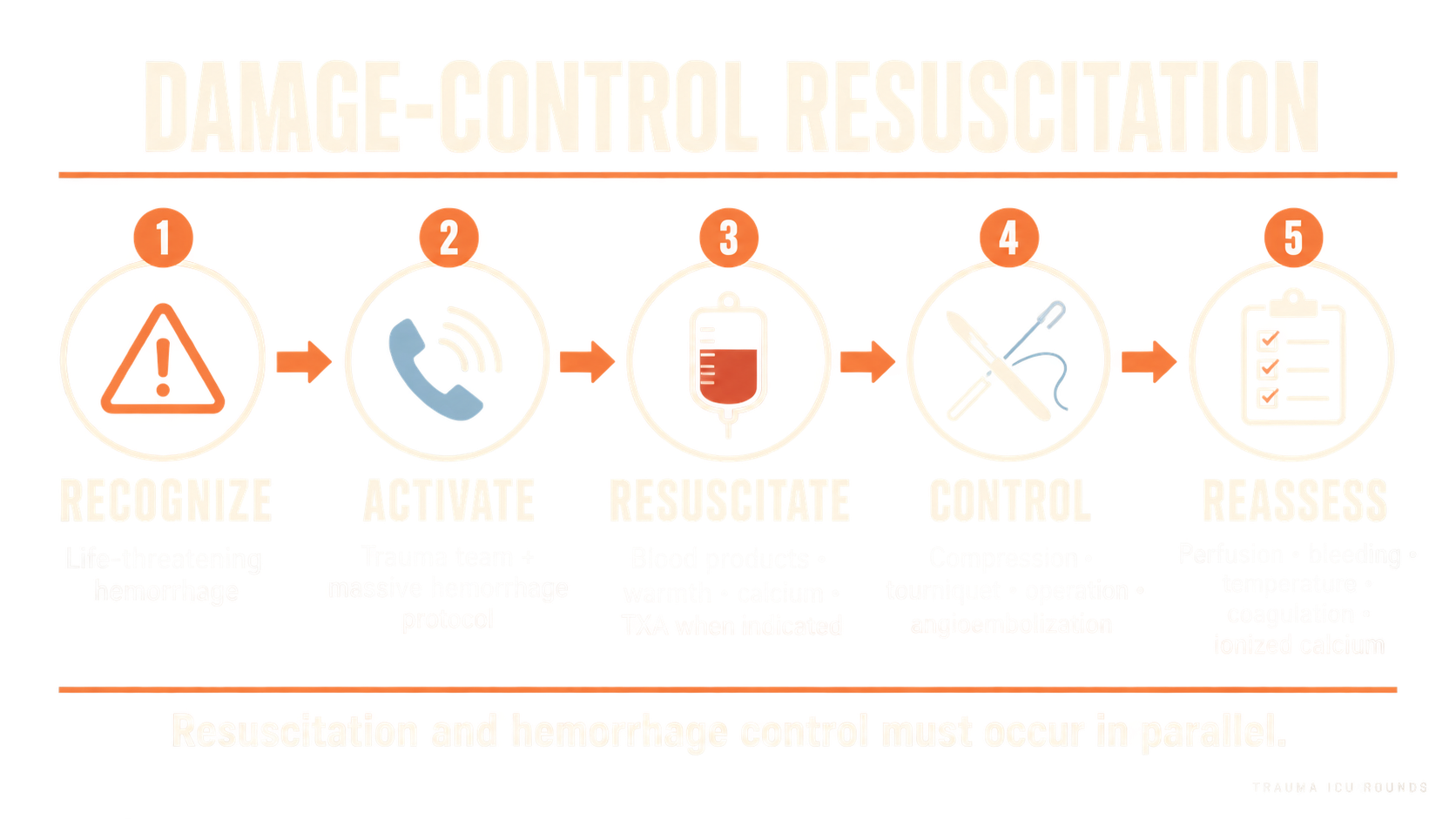
Recognize life-threatening hemorrhage
Do not wait for the patient to meet a retrospective definition of massive transfusion.
Suspect critical hemorrhage when there is:
Active external or internal bleeding
Shock or worsening tissue hypoperfusion
Transient or absent response to initial resuscitation
A high-risk mechanism or injury pattern
Anticipated need for urgent operative or endovascular control
Rapid or continuing requirement for blood products
Hemoglobin may remain deceptively normal early in hemorrhage. The diagnosis depends on the overall trajectory—not one blood pressure, laboratory value or imaging result.
Recognition principle
Hypotension is not required to diagnose shock, and hypotension alone does not identify its mechanism.
Look for impaired perfusion, ongoing blood loss and the patient’s response to treatment.
The Lethal Diamond
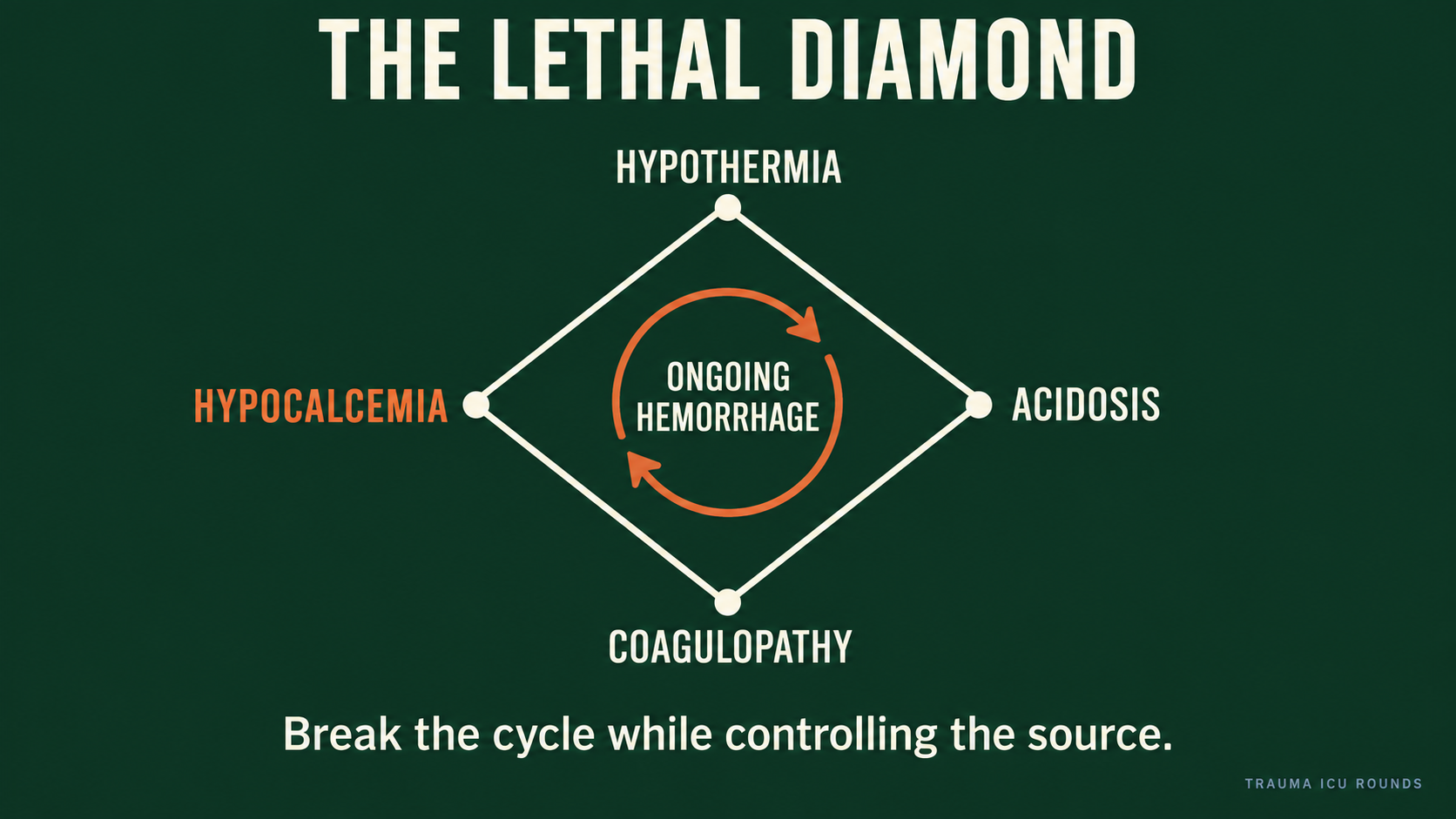
Major hemorrhage initiates a self-amplifying cycle of physiologic failure.
Hypothermia impairs enzymatic coagulation and platelet function.
Acidosis reduces coagulation-factor activity and myocardial performance.
Coagulopathy may begin with the injury and is then aggravated by shock, dilution and consumption.
Hypocalcemia compromises coagulation, myocardial contraction and vascular tone.
Damage-control resuscitation aims to interrupt all four processes while the source of hemorrhage is being controlled.
1. Control the source
Resuscitation cannot compensate for uncontrolled hemorrhage. Apply immediate external control where possible and move decisively toward operative, endovascular or other definitive intervention.
2. Minimize crystalloid
Large-volume crystalloid resuscitation can worsen dilution, tissue edema, hypothermia and coagulopathy. Use blood products early when major hemorrhage is suspected rather than repeatedly treating the blood pressure with crystalloid.
3. Restore hemostatic capacity
During active major hemorrhage, begin protocolized blood-product resuscitation according to the local massive hemorrhage protocol. Use an empiric balanced strategy initially, then transition toward laboratory- or viscoelastic-guided treatment as reliable results become available.
PROPPR found no statistically significant difference in overall 24-hour or 30-day mortality between 1:1:1 and 1:1:2 resuscitation, but 1:1:1 produced more hemostasis and fewer early deaths from exsanguination. Present it as support for early balanced resuscitation—not proof that one fixed ratio is universally superior. PROPPR trial
4. Use pressure strategically
In patients without severe traumatic brain injury, restricted-volume resuscitation and a lower blood-pressure target may limit further bleeding until hemorrhage control is achieved. Patients with significant TBI require sufficient pressure to support cerebral perfusion.
Do not chase a normal blood pressure before hemorrhage control. Do not accept inadequate cerebral perfusion in TBI.
5. Protect temperature and calcium
Warm the patient, environment, fluids and blood products. Monitor core temperature and ionized calcium during ongoing transfusion. Citrate exposure can rapidly worsen hypocalcemia during massive transfusion.
6. Give adjuncts deliberately
Administer tranexamic acid early when the patient meets the applicable trauma protocol—ideally as soon as possible and within three hours of injury.
Monitor fibrinogen and replace it according to laboratory or viscoelastic findings and local practice.
Six priorities in damage-control resuscitation
At the Bedside
Resuscitate
Activate the massive hemorrhage protocol
Establish rapid blood-product delivery
Minimize crystalloid
Give TXA when indicated
Warm the patient and all infusions
Monitor ionized calcium
Follow lactate or base deficit
Repeat coagulation assessment
Communicate product requirements clearly
Control
Apply direct pressure or wound packing
Use a tourniquet when appropriate
Stabilize the pelvis when indicated
Proceed to urgent operation
Mobilize interventional radiology
Reassess every temporary hemorrhage-control measure
Declare when definitive control has been achieved
The most important intervention remains definitive hemorrhage control.
Reassess continuously
Damage-control resuscitation is a dynamic process. After every major intervention, ask:
Is the patient still bleeding?
Is tissue perfusion improving?
Is definitive hemorrhage control progressing?
Are temperature, ionized calcium and acid–base status improving?
Is empiric transfusion still required?
Can resuscitation transition to laboratory- or viscoelastic-guided therapy?
Is it time to terminate the massive hemorrhage protocol?
Useful trends include:
Mental status
Skin perfusion
Urine output
Blood pressure and pulse pressure
Lactate or base deficit
Core temperature
Ionized calcium
Hemoglobin and platelet count
Fibrinogen
Conventional coagulation tests
TEG or ROTEM, when available
The endpoint is not a normal-looking monitor.
It is controlled hemorrhage with recovering perfusion and corrected physiology.
Transition From Empiric to Targeted Resuscitation
Empiric balanced transfusion is an early strategy for a rapidly evolving emergency. It should not continue automatically once the situation becomes clearer.
As reliable laboratory or viscoelastic results become available:
Identify the remaining coagulation deficit
Target platelets, fibrinogen and plasma appropriately
Avoid unnecessary blood-product exposure
Continue monitoring temperature and ionized calcium
Confirm that hemorrhage control has been achieved
Deactivate the massive hemorrhage protocol when ongoing protocolized delivery is no longer required
The resuscitation strategy should evolve as the patient’s physiology evolves.
Rounds Takeaways
Damage-control resuscitation is not a transfusion ratio. It is an integrated strategy for the bleeding trauma patient.
Recognize critical hemorrhage early.
Activate the team and blood bank before collapse.
Control hemorrhage and resuscitate simultaneously.
Minimize crystalloid.
Use early hemostatic blood-product resuscitation.
Prevent hypothermia and monitor ionized calcium.
Use TXA early when indicated.
Move from empiric therapy to targeted correction.
Reassess until bleeding is controlled and perfusion is restored.
Blood buys time. Hemorrhage control saves the patient.
Continue on Rounds
Whole Blood in Trauma
Where whole blood fits within contemporary trauma resuscitation—and what the latest clinical trials tell us.
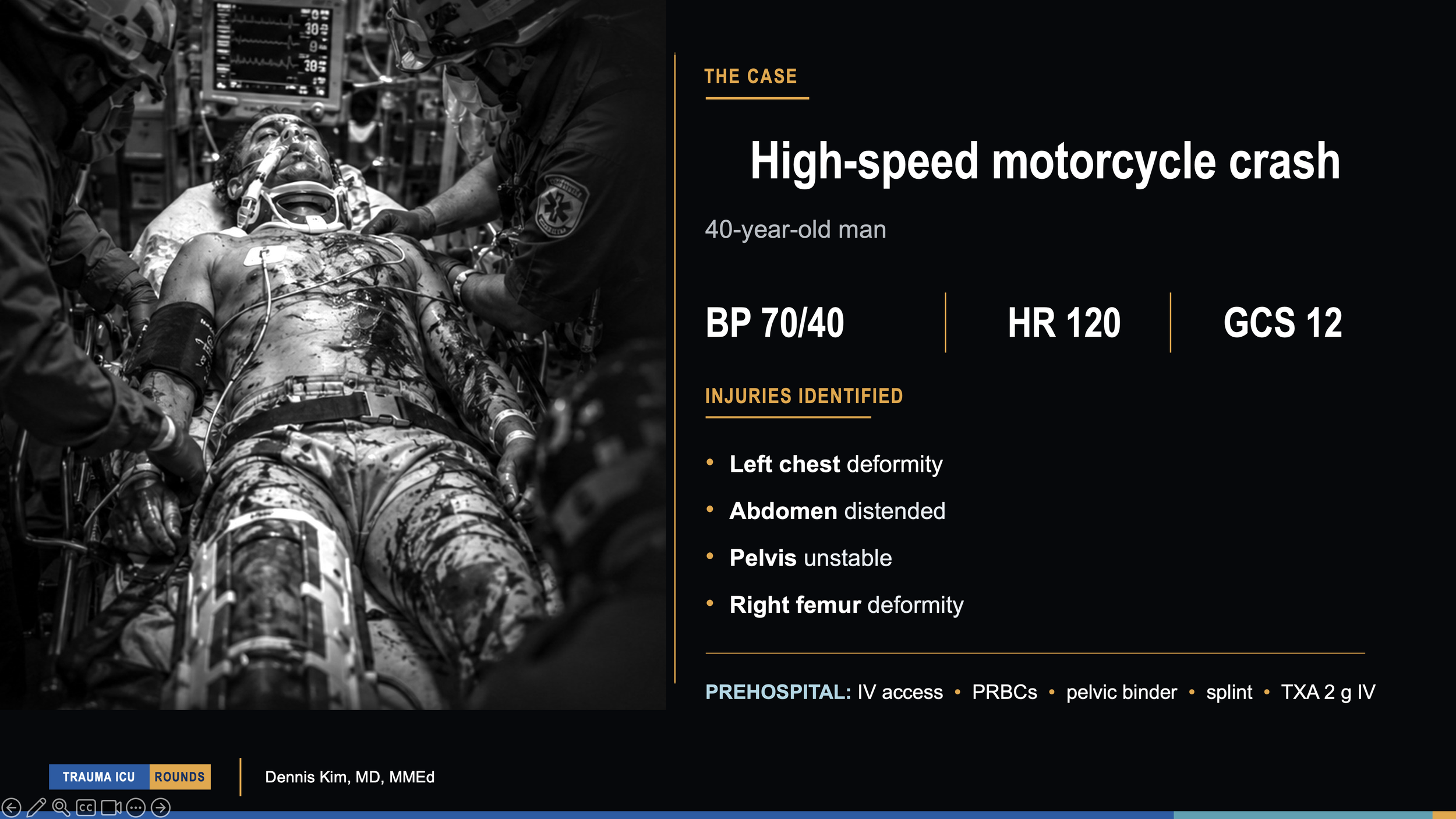
Hemorrhage & Resuscitation
Explore videos on damage-control resuscitation, whole blood, massive transfusion and hemorrhagic shock.
Clinical Guidelines and Resources
AAST/ACS-COT Clinical Protocol for Damage-Control Resuscitation
A contemporary North American consensus protocol addressing recognition, hemorrhage control, blood-product resuscitation, blood-pressure targets, temperature, calcium and reassessment.
European Guideline on Major Bleeding and Coagulopathy Following Trauma
Comprehensive recommendations covering hemorrhage control, coagulation management, blood products, TXA, calcium, temperature and blood-pressure targets.
READ THE SIXTH-EDITION GUIDELINE
Joint Trauma System Damage-Control Resuscitation Guideline
Operational guidance developed for military, prehospital and austere trauma environments.
Ontario Massive Hemorrhage Protocol Toolkit
A practical Canadian resource for designing, implementing and evaluating a hospital massive hemorrhage protocol.
Canadian Blood Services: Massive Hemorrhage Protocol
Canadian educational material addressing MHP activation, team response, transfusion, testing, TXA, temperature and protocol termination.
Selected Evidence
PROPPR
Holcomb JB, Tilley BC, Baraniuk S, et al. Transfusion of plasma, platelets, and red blood cells in a 1:1:1 versus a 1:1:2 ratio and mortality in patients with severe trauma. JAMA. 2015;313(5):471–482.
CRASH-2
CRASH-2 Trial Collaborators. Effects of tranexamic acid on death, vascular occlusive events and blood transfusion in patients with significant traumatic hemorrhage. Lancet. 2010;376(9734):23–32.
CRYOSTAT-2
Davenport R, Curry N, Fox EE, et al. Early and empirical high-dose cryoprecipitate for hemorrhage after traumatic injury. JAMA. 2023;330(19):1882–1891.
Hypocalcemia in Trauma
Vasudeva M, Mathew JK, Fitzgerald MC, et al. Hypocalcemia in trauma patients: a systematic review. Journal of Trauma and Acute Care Surgery. 2021;90(2):396–402.
Educational content for clinicians. Management should be adapted to the patient, available resources and local massive hemorrhage protocol.